

WORLD GUIDE
This world guide serves as a reference to the setting, history, religion, and magic of the World of Urn—the realm of the Guardians of the Maiden series and the Chronicles of Urn.
AZURE KINGDOM
The Kingdom of Azure:
Located within Urn’s Chip, the eastern land is joined to the mainland by a narrow isthmus. Once known as the Everfrost, it fell under the dominion of the God of Death and the Ten Clans before rising as the Kingdom of Azure, marked by its sigil of a seven-pointed star.
Other territories within Urn’s Chip during the Era of the Ice Phoenix (EIP) include:
The Frost Lands:
Territory of the Skellings, lying north of Azure beyond the Hermon Mountains. These fae, said to have been created by the God of Death, can take the form of massive hawks and wield storms as weapons. During the Era of the Ice Phoenix, their domain briefly extended into the mountains, but after heavy losses in the Dark War (TDW), also known as the Endless Night, they retreated into the deep Frost Lands. It is believed they still endure there, shaped by the cold into something more than they once were.
The Waste Lands:
Once the domain of the God of Shadows and his demons, this southern expanse later fell and was absorbed into the Kingdom of Azure and the Realm of Hilos following his defeat.
The Moore Lands:
A small kingdom of the Wild Fae, ruled by King Dagden, which endures to this day. Though no longer recognized by Azure on maps or in trade, the Wild Fae remain—largely untouched, and largely forgotten.
URN MAINLAND KINGDOMS
The Magos Empire:
A southern kingdom of mages divided into three guilds: Sun, Lunar, and Earth. It is currently ruled by the Earth Archmage and remains closed to outsiders. Their society is governed by the Mage Code, a strict and oppressive system that limits the rights and magic of sorceresses. Their sigil bears the triad of all three guilds.
The Xián Jīng Dynasty:
Situated along the western coast of Urn, this kingdom was once a dominant power during the Era of the Ice Phoenix and a center of trade. It remains influential today, known for its dragons and marked by a fire-breathing dragon sigil.
The Vale of the Elves:
Once a single realm in the mid-west, the Vale has since fractured into two warring kingdoms: Red Highland, bearing the red maple sigil, and Greenwood, marked by the Dynalya flower. Elves now identify themselves as red or green, though the differences between them are slight. As war persists, both kingdoms forbid unions between their people. Those who defy this law are exiled—or executed. Many now bear tattoos of their kingdom’s sigil as a mark of allegiance.
The Kingdom of Argyle:
A northern kingdom nestled near the Montezuma Mountains, known for its quiet beauty, rolling valleys, and relative peace. Once bearing the sigil of a stag, Argyle later adopted the black dragon crest—said to honor the ancient power that watches over the mountains.
In earlier ages, the range was known as Karag Dûr before it was renamed after the Minotaur Zuma, who is credited with saving a prince of Argyle.
The United Crown:
One of the oldest kingdoms in Urn, located in the north. Its lands are rich with gold, lending it great wealth. The climate is temperate, with cold, humid winters and long summers. There the sun rarely sets.
Harromag Modos:
A vast desert in the northwest, marked by its sigil of shifting dunes. It is home to many creatures, as well as humans and the dragons that dwell within its canyon depths. Urn’s National Railroad cuts across the desert, linking the interior to the western coast.
Other continents mentioned in the Guardians series and the Chronicles series but not shown on the maps: Carthage, Arthal, and Versai.
THE REALMS
The Realms are the hidden territories of the Celestials, ancestors of the Forsaken, the seraphs who fell during the First Age. Established after the Dark War, each Realm exists beyond mortal sight, its borders guarded by Watchers and sealed against intrusion. Though hidden, the Realms are not beyond reach, only beyond mercy.
Hilos:
The central kingdom and seat of the High King, Hilos governs the Four Celestial Realms. Its colors are white and gold, marked by the sigil of a crowned sword of flame.
Each Realm is ruled by an appointed Lord.
Nazar:
The first realm, set among the floating islands above the Vale of the Elves, concealed within the clouds. Its color is yellow, bearing the sigil of a sun fanned by six wings.
Edym:
The second realm, hidden within an oasis in the desert of Harromag Modos. Its Celestials have adapted to heat and the harsh sun, bearing warmer features. Its color is red, marked by the sigil of two wings crossed with twin blades.
Skath:
The third realm, found in the frozen lands of the north. Its Celestials have adapted to the cold, able to endure and fly within the ice-bound skies. Its color is purple, bearing the sigil of a shield set aflame.
Hermon Ridge:
The fourth and youngest realm, founded five hundred years ago within the Hermon Mountains. It became the refuge of the Nephilim—those born of mixed blood during the Decimation. All who are born since are sent there. Its color is blue, marked by the sigil of a tree within a mountain.
CELESTIAL HISTORY
The Forsaken fell to the Mortal Realm at the end of the Era of the Ice Phoenix. Once seraphs of Heaven’s Gate, they were cast out for disobedience and bound to a new purpose. To atone, they were tasked with protecting the Mortal Realm from the God of Shadows and his demons.
They were led by Kahssiel, the only seraph who chose to descend of his own will. For this, he retained all six of his wings and was granted seraph fire. He led both his kind and the armies of men through the Dark War, and after years of conflict, the God of Shadows was defeated.
In the aftermath, the Kingdom of Hilos was established in the southern Waste Lands as reward for their victory, and Kahssiel was crowned king of the seraphs.
The seraphs believed their exile to be temporary, a trial to regain Elyōn’s favor and return to Heaven’s Gate upon death. They lived by strict holy law, keeping to the traditions of the Heavens and its language. They took no meat, drank no spirits, and formed unions only among their own kind. Their children, born with two wings that emerged in early childhood, came to be known as Celestials, those belonging to the Heavens.
This order was broken when King Kahssiel chose a human as his mate. His people named the union an abomination, an offense to their god. A coup was led by his three generals, ending in the deaths of both king and queen.
Yet the act did not go unjudged. Elyōn rebuked the generals and cast them out from Hilos. They fled west and, in time, founded the realms of Nazar, Edym, and Skath.
Kahssiel left no heirs. His brother took the throne, and his bloodline was bound so that it could never again be challenged. From that moment forward, unions with humans were forbidden, and a doctrine of pureblood lineage took root. Even so, the Forsaken continued to aid humankind for many centuries, honoring the penance that had been set upon them.
During the reign of High King Rael, the Celestials suffered what is now known as the Decimation. It was discovered that their blood could heal any ailment, and their feathers could amplify magic. What began as trade with the Kingdom of Azure, centered in the city of Gamor, soon turned to slaughter when humans began to hunt them instead.
Bound by holy law, the Celestials did not strike back. Many believed the suffering to be another judgment from Elyōn. Their people were killed in great numbers, and their women taken to bear Nephilim, children of mixed blood. The hunts spread across all realms.
High Queen Sapphira, mate to High King Rael, sought peace with the lords of Gamor. It ended in her death.
Her loss broke what restraint remained. King Rael led his army upon Gamor and razed it to the ground. From that day forward, all ties with humanity were severed.
The fall of Gamor stood as warning to the Kingdom of Azure, and the hunting of Celestials was declared illegal. King Rael withdrew his people from the world and set Watchers upon the borders of the Realms to guard against intrusion. He then established the Accords, laws designed to preserve the existence of the Celestials.
All mystical beings of Urn, from wolves to elves to fae, and every sovereign among them, are bound to this secrecy.
For over five hundred years, the Celestials have remained hidden within their Realms. In time, the world forgot them, and the winged beings of the Heavens passed into legend.
MAGIC USE IN URN
Magic in Urn is drawn from life force energy, found either within nature or within the wielder.
Elves draw Essence from the natural world around them. Their power is vast, but not without cost. It places great strain upon the body and requires years of disciplined study. Their magic relies on complex spellwork, including long incantations and intricate runes, and many devote decades to mastery within specialized schools of magic.
Mages and sorceresses draw Essence from their own life force. This Essence takes on the color of their aura, which may shift over time but rarely changes completely. Unlike elves, their power is finite. To draw too deeply risks exhaustion, unconsciousness, or death. Most spend years strengthening their life force to expand the limits of what they can wield.
Because of these differing sources, one rule is held above all others: the magic of elves and mages must never be combined. The result is known to be unstable and often catastrophic. The few who have attempted it rarely survived.
Mages are born into one of three guilds: Earth, Lunar, or Sun. Their abilities are tied to their element, though certain disciplines are shared across all guilds, including levitation, shielding, and cognition magic of the mind.
On rare occasion, a Transcendent is born, possessing the ability to wield all three elements. Such individuals are taken in youth and raised under the Archmage, where they are bound to the royal line so their power may continue through blood.
A mage’s power first awakens during the Rising Sleep, which occurs around the age of six. During this time, the child will begin to float as their Essence manifests. The state may last several nights before the magic settles. No other race is known to experience this.
Most beings within Urn possess some connection to magic. Humans do not. They may only access it through enchanted artifacts or by turning to witchcraft, which draws upon darker forces through dealings with demons.
Magical objects are common and often woven into daily life. Enchanted artifacts are typically spelled through runes, crafted for specific purposes. Tanzanite crystals may be imbued with singular spells, such as light or shielding. Orbs are used for communication and are bound to their owner. Staffs are set with crystals to focus and amplify power. Even clothing, weapons, armor, and structures may be enchanted.
MAGICAL ARTIFACTS
Magical artifacts in Urn are objects imbued with Essence through spellwork, runes, or rare materials. Many are woven into daily life, while others are closely guarded due to their power.
Stardust:
Formed from crushed meteorite, stardust is known for its ability to create pockets of limitless space.
Pixie Dust:
Granted only through bargains with pixies, this dust allows the user to shrink themselves or objects. It is most often used for travel, though its effects are not always predictable.
Celestial Feathers:
Feathers taken from Celestials carry potent healing properties. They may also be used to amplify magic, allowing a wielder to draw upon the full force of their power in a single moment.
Crystals:
Various crystals and ores appear throughout Urn, each with unique properties. They are often inscribed with runes or bound with incantations to cast spells. Mages frequently set them into staffs to focus and enhance their magic.
Enchanted Mirrors:
There are four known mirrors of power. The Sun Mirror requires blood to reveal what will be. The Moon Mirror requires tears to reveal what once was. The Water Mirror requires salt to reveal what is. The Earth Mirror remains the most elusive, said to answer to desire itself… though what it reveals is rarely without consequence.
Night Ash:
The base form of Nightstone, created from crushed meteorite and demon blood gathered during the Blood Moon. It is used in warding circles and in the forging of Nightstone weapons, which are capable of striking down demons.
Jewelry:
Jewelry across Urn is often enchanted for a wide range of purposes. The Hyalus necklace, for example, is used to cast light. Elves craft their adornments from rare ore to alter appearance or enhance ability. Fae spell their jewelry for countless uses, though such magic often carries unintended consequences. Mages, by contrast, use enchanted jewelry to contain or suppress their power, and to shield themselves from detection.
ENCHANTED ORE
Enchanted ore was once abundant during the Era of the Ice Phoenix, but much of it was lost or destroyed over the centuries and is now exceedingly rare. In its absence, natural ores have been mined and adapted for magical use, often crafted into communication orbs and Essence-enhancing tools.
Much of the enchanted ore that remains in Urn today is said to have been created through the power of the God of Death, often in collaboration with the Guilds or through the forging of magical artifacts.
Nightstone: A black crystal forged from meteorite and demon blood harvested beneath a lunar eclipse, wrought for the slaughter of demons.
Moonstone: A white crystal that reflects moonlight to deter or slay demons. It may also be enchanted for other purposes.
Bloodstone: A red ore forged through blood magic, capable of binding its wearer within a fixed perimeter to protect them from outside forces. For example, sunlight. In later years, its use was corrupted by slave keepers to restrain their captives.
Tanztone: Also known as Tanzanite, a versatile pale blue crystal capable of holding a single spell. It may be used only once and cannot be spelled again.
Sunstone: An orange crystal forged from living sunfire. It was used to reflect sunlight to deter or slay demons. Can be spelled for other uses. First wrought to defeat the God of Shadows, it was scoured from the earth upon his return.
Hellstone: A natural ore drawn from the Abyss, dark as a starless night and veined in crimson. It was shaped into a divine prison to contain the Primordials, and even the smallest shards can bind lesser gods and demons.
ENCHANTED TREES
Certain trees in Urn are not bound by natural law, but by divine influence, growing as vessels of power, fate, and memory.
Hyalus Trees:
Also known as the Glass Tree, the Hyalus bears a silvery trunk and translucent leaves that shimmer like glass. Said to be Elyōn’s tree, it grows within each of the Celestial Realms. Its leaves glow softly at night and blaze with light once a year during the Festival of Light, and again upon the crowning of a new High King.
Azure Trees:
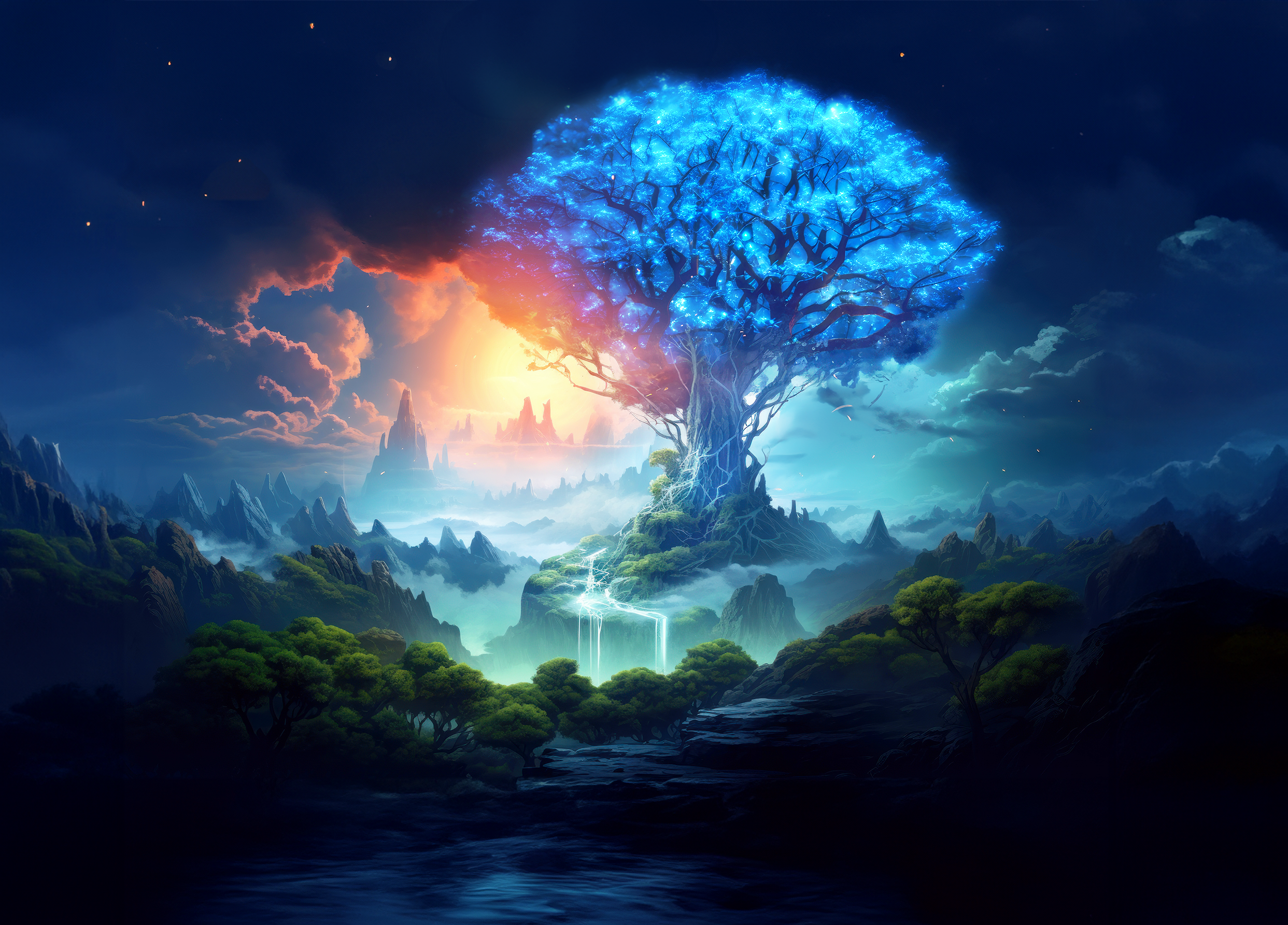
Marked by white bark and sapphire-blue leaves that glimmer like stars, these trees appear without pattern in places of strong magic or woven fate. Their power is unpredictable, and their true purpose remains unknown.
Tree of the Unending:
A rare and sacred tree with pale branches and gold-laced leaves. It is said that any who consume its fruit may gain power over life and death.
Elder Trees:
Ancient trees capable of forming gateways between distant places. These portals are bound by range and require the power of a Magi Master or Grand Magus to awaken. They are believed to have been first created by the Goddess of Shadows.
Anar Tree:
The Forbidden Tree hidden within the lowest level of the Seven Hells within the Netherworld. It bears branches of eternal white flame and ambrosia-like fruit whose scent and taste drive mortals mad. Male demons must cross all Seven Hells and endure its burning light for the chance to claim its fruit. If they succeed, the fruit is offered to their chosen mate as a sacred gift.
MAGICAL FLORA
Certain flowers within Urn are not bound by natural law, but by divine influence, growing as extensions of power, death, and will.
The Enchanted Rose, a blue rose created by the God of Death, is said to never wither. In a realm defined by frost and decay, it stands as an enduring bloom in a land where nothing else survives unchanged.
In contrast, the Blood Blooms, also known as spider lilies, grow only within the Netherworld. Often called the corpse flower of the damned, they are forbidden to touch and feared even among demonkind. These flowers mark thin places between realms, where the boundary between life and death weakens. Their presence is said to signal awakening, calamity, or the coming of the Devourer itself.
THE GODS
Religion in Urn is based on the seven gods. While not all are revered, their existence is known. The Kingdom of Azure based their sigil of a seven-pointed star on the gods.The God of Urn and of Life (Elyōn) is the most acknowledged.
Elyōn: the God of Life and maker of the gods, souls, and the Seven Gates. (A Primordial)
Gavriel: Goddess of the Heavens who oversees the River of Souls
Hiram: The God of Time who oversees the past, present, and the future.
Zohar: The God of Space and Dimension, who oversees the bridges between the Realms.
Eitan: The God of Mortals who oversees the natural laws of life.
Rumiel: The God of Shadows who oversees the Netherworld and the damned.
Jökull: The God of Death who guides souls through the Seven Gates at their beginning and at their end.
THE PRIMORDIALS
The Primordials are ancient, unknowable entities that existed before the gods and the shaping of the realms. They are not deities, but Titans. Forces of hunger and entropy, embodying the unmaking of creation itself. Where the gods bring order, the Primordials bring chaos.
Long ago, the Primordial Elyōn rose against his own kind, leading an army of Seraphs to imprison the others within the Abyss, the deepest pit beneath the Netherworld. Their prison was forged from hellstone, the only material capable of binding something so vast and formless. In the ages that followed, Elyōn became known as the God of Life and creator of the Seven Gods of the Seven Gates—the new gods worshipped across Urn today. Some believe the very pillars of the world are built upon the prison holding the Primordials, and that the realms endure only so long as the Primordials remain contained.
Among them was Vorak, known as the Devourer, whose influence still seeps through shadow and blood. Unlike the others, Vorak was not entirely dormant, and his hunger was said to extend even to divine power. Even Elyōn, who once stood as their jailer, is not untouched by what lies beneath. It is said that when Vorak once broke free, he was cast down again by the God of Shadows and the Goddess of Shadows.
Most mortals are unaware the Primordials exist. But in forbidden texts and ancient whispers, a darker truth remains: the world is not built upon stable ground, but upon a prison—and something beneath it is always trying to wake.
THE DOMINIONS:
Those Who Rule the Seven Factions of the Netherworld
Pride: ruled by Rune, the God of Shadows
Envy: ruled by Alora, the Goddess of Shadows
Lust: ruled by Lady Calla
Wrath: ruled by Lord Hadeon
Gluttony: ruled by Lord Deimos
Sloth: ruled by Lady Segrith
Greed: ruled by Lady Nexia
THE DIVINE LAWS
The gods of Urn are bound by three sacred laws set forth by Elyōn, the God of Life—laws that govern the balance of existence itself.
Do not desecrate souls.
Do not resurrect the dead.
Do not disrupt the flow of time.
These laws are absolute. Though the Fates may at times allow them to be bent, even the gods themselves are not exempt from the consequences. It is said such transgressions risk the balance of the Realms and create a Rift.
RIFTS
Rifts are tears in the fabric of the Realms, formed through the desecration of a soul—the gravest violation of the Divine Three Laws. They are rare and catastrophic, marking a fracture in existence itself when something sacred has been broken beyond its natural design.
Within a Rift, the boundaries between realms begin to fail. Space distorts, time falters, and the balance between life and death unravels. What begins as a fracture can spread, consuming land, magic, and even entire realms if left unchecked.
Some believe the Primordials stir within these ruptures, drawn to the instability. Others claim a Rift is not merely destruction, but a warning that the world itself is unraveling.
THE SEVEN GATES
Each soul passes through the gates at their beginning and their end.
Heaven’s Gate, Life Gate, Spatial Gate, Time Gate, Mortal Gate, Netherworld Gate, and Death’s Gate.
The Seven Gates are divine thresholds created by Elyōn, the God of Life, to govern the journey of every soul. Each Gate is watched over by one of the Seven Gods and marks a passage through existence itself, from creation to death, and beyond.
Every soul passes through all Seven Gates at both their beginning and their end. From Heaven’s Gate, souls emerge from the River of Souls and are brought into being. They are given life through the Life Gate, then carried through the Spatial and Time Gates, where form, place, and fate are shaped. From there, they pass through the Mortal Gate and enter the living world.
Upon death, the journey continues. Souls pass through Death’s Gate, where their fate is determined. Those who are judged worthy return to Heaven’s Gate to rest, while others are cast through the Netherworld Gate for punishment.
The Gates are not merely paths, but the foundation of existence itself. Through them, life is given, lived, judged, and renewed. An eternal cycle that binds all beings within the order Elyōn created.